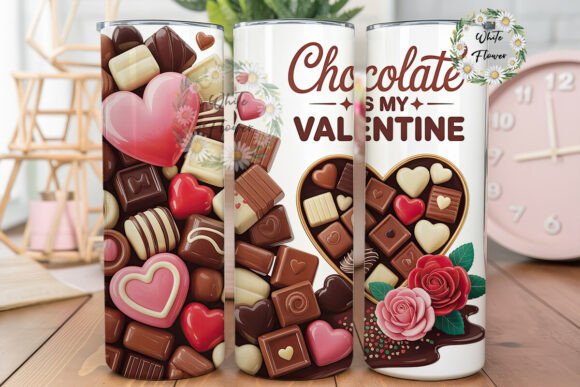
Review: Chocolate Valentine 20oz Tumbler Wrap for Crafters
As a designer who spends more time staring at stitch maps than most people spend on their phones, I approach every new embroidery file with a mix of curiosity and skepticism. We have all downloaded a "perfect" design only to find it turns into a bird's nest of thread on the machine. Today, I am taking a close look at the Chocolate Valentine 20oz Tumbler Wrap. While the title suggests a sublimation or vinyl application for drinkware, my job is to translate this graphic into a tangible machine embroidery design that works for custom apparel, patches, and boutique merchandise.
The first thing that strikes me about this asset is its specific dimensional requirement. The instructions state you will need to size the design to 9.3" x 8.2" in your choice of image editing software. This is a substantial footprint. In the world of embroidery, an 8-inch wide design is not something you slap onto a standard left-chest logo spot. This immediately tells me that the Chocolate Valentine 20oz Tumbler Wrap is intended for large-format applications. It screams "back of the sweatshirt" or "full front tote bag." The mood here is bold and celebratory, leaning heavily into the cozy, indulgent vibe of a chocolate-themed Valentine's Day.
Translating Graphics into Stitch Reality
The product description notes that this falls under Tumbler Wraps and Graphics, providing one straight file and one tapered file at 300 DPI. As an embroiderer, I cannot simply load a PNG or JPG into my machine. To make this work as a finished product, I have to digitize it or use it as a template for appliqué. The high resolution is a massive plus here; it means the lines are crisp enough to trace for satin columns or define fill areas without pixelation ruining the stitch path.
Imagine a scenario where you are preparing a holiday gift for a client who runs a local coffee shop. They want a limited-run staff uniform for February. You could take the visual elements from the Chocolate Valentine 20oz Tumbler Wrap and adapt them into a large applique design for the back of a heavy cotton canvas apron. The "chocolate" theme suggests rich browns, creams, and perhaps deep reds. When translating this to thread, you would want to prioritize satin stitch for any text or outlines to give it that premium, glossy look, while using fill stitch for larger background shapes to keep the garment flexible.
However, there is a catch. The description mentions the design is not seamless. If you are planning to wrap this around a cylindrical object like an actual tumbler using embroidery (which is difficult but possible with specialized jigs), the break in the pattern will be visible. For flat applications like a tote bag design or a sweatshirt embroidery project, this is less of an issue, provided you center it correctly. The tapered file option is interesting; it hints that the original graphic was meant to curve. If you are digitizing this for a cap, that taper might actually help compensate for the curvature of the front panel, though I would still advise caution.
Fabric Selection and Stitch Density Considerations
One of the biggest challenges with a design of this scale (9.3" x 8.2") is stitch density. If you blindly convert this graphic into a solid fill, you will end up with a cardboard-like patch that creates tension issues on stretchy fabrics. For a custom apparel item like a tri-blend tee or a baby onesie, this density would be disastrous. My professional recommendation is to treat this as a layered project.
If you are creating an embroidered patch to sell in your small shop product line, you have more freedom. You can use a dense merrow edge and heavy stabilizer. But for direct-to-garment embroidery, you need to be strategic. Use running stitch for fine details to reduce bulk. Pay close attention to the "chocolate" elements; if these are large blocks of color, consider breaking them up with texture stitches or leaving small gaps to let the fabric texture breathe. This prevents the design from looking like a plastic sticker stuck on the cloth.
There are specific situations where you should use the Chocolate Valentine 20oz Tumbler Wrap carefully. Avoid placing this on thin, lightweight fabrics like rayon or silk blouses unless you are using a cut-away stabilizer and framing it properly. The weight of an 8-inch design will pull down a light fabric, causing sagging over time. Similarly, be wary of dark fabrics if the original graphic relies on light colors without defined outlines. Always test your thread colors against the garment base. A cream-colored chocolate swirl might disappear on a beige sweatshirt, killing the visual impact.
Commercial Viability and Brand Consistency
For Etsy sellers and creative entrepreneurs, the value of a design lies in its versatility. Can this asset support a whole collection? Absolutely. The Valentine theme is evergreen for Q1 sales. You could use elements of this graphic to create matching sets: a large version for a blanket, a scaled-down version for a baby embroidery project on a bib, and a simplified icon for a hat. This consistency builds brand recognition.
When selling handmade products, presentation is everything. A well-executed version of this design signals professionalism. Customers trust a vendor whose stitching is clean, whose registration is perfect, and whose design choices feel intentional. If you rush the digitization process and end up with puckering or thread breaks, it reflects poorly on your craft business. Take the time to create a printable mockup first. Visualize how the 9.3" width sits on a standard 15" x 15" tote bag. Does it overwhelm the bag? Or does it look luxurious and full?
Practical Designer Notes for Execution
Before you commit to stitching this on a client's expensive hoodie, follow these practical steps:
- Test on Scrap Fabric: Never skip the test run. Use the same fabric weight and type you intend to use for the final embroidery project.
- Check Hoop Size: An 8.2" height requires a large hoop. Ensure your machine can handle this area, or be prepared to do a re-hoop, which risks alignment errors.
- Inspect Small Details: Look at the 300 DPI file closely. Are there tiny isolated islands of color? These might need to be merged or removed to prevent thread trimming nightmares.
- Stabilizer Strategy: For a design this big, a single layer of tear-away is likely insufficient. Consider a combination of cut-away and water-soluble topping, especially if working with towels or textured fabrics.
- Licensing Check: The description says "Free of watermark," but always confirm the license terms. Can you sell the digitized version? Can you sell the physical items? Clarify this before listing items in your digital embroidery file shop or boutique.
In conclusion, the Chocolate Valentine 20oz Tumbler Wrap offers a strong visual foundation for seasonal products. It is not a plug-and-play embroidery file right out of the box since it is a graphic, but for a skilled designer, it is a goldmine of potential. Whether you are making holiday embroidery gifts, updating your commercial embroidery catalog, or crafting a personalized gift for a loved one, the key lies in how you adapt the graphic to the medium. Respect the scale, manage the density, and choose your materials wisely, and this design can elevate your spring collection significantly.